You have plane tickets and you’ve already chosen a place to stay; now all that’s left is to find a car to take you from place to place.
When we fly for non-city trips in Europe, we prefer to rent a car rather than rely on public transport, especially in Eastern Europe, where the public transport infrastructure is often not convenient enough.
Car costs depend on a range of variables such as the type of car, the destination where you rent, the rental period and which extras you’ll need to add. On our trip inwestern Romania we rented a car for €12 a day through Rentalcars; on our visit toRome we rented a car for one day at €9 a day through the website Economy Car Rentals.
Let’s start with an explanation of my favorite search engine, which I use to start every car rental search. Later I’ll share important points to pay attention to when renting a car abroad.

Tip #1
The earlier you book, the cheaper the price.
So whenever I book a flight, I also book a car with a cancellation option.
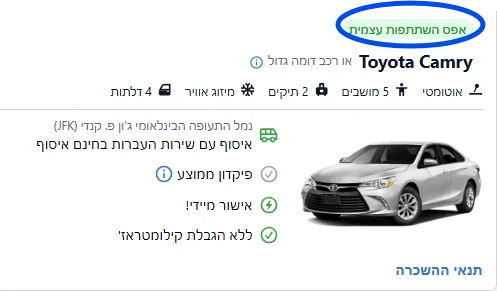
In the past I recommended certain sites for booking a rental car abroad; since then I’ve discovered a search engine called DiscoverCars. The DiscoverCars search engine is my favorite today. After you fill in the location and dates, you can view a list of suitable cars, each rated on various measures such as value for money and the car’s condition.
It’s important to remember that most bookings allow cancellation up to 48 hours before the rental date, so as in the first tip, it’s recommended to book as early as possible and at most cancel later. Set yourself a reminder in your calendar to cancel three days before the trip.
In some cases only a deposit is required (and in some, full payment in advance). Pay attention to whether the deposit amount is refundable or not.
It’s very important to read the fine print when booking a car!
Car Rental Insurance:
When booking a car it’s important to check that there’s collision damage insurance (CDW) and theft protection (TP) for the car.
What exactly is excess waiver and why do I need it if I already have insurance?
Even if there’s collision insurance, in the event of an accident (or even a scratch) you’ll still be charged an excess (deductible). Of course the excess amount varies according to the damage to the car and the type of car, but different rental companies will also require different deposits and excess fees.
For example, for the last car rental I made, the maximum excess amount was as shown in the picture:

If your booking doesn’t include excess waiver, you can always add excess waiver when you pick up the car from the rental company abroad.
If you don’t like the final price of offers with excess waiver (since they’re more expensive), or you haven’t found a car that suits you that includes excess waiver, and you do want to complete the booking and get insurance that protects you, you have another option (usually even cheaper): adding excess reimbursement insurance. What does excess reimbursement mean? If there’s damage to the car, you’ll be required to pay the cost of the repair (up to the amount of the deposit, as in the picture above) and then claim a refund of the amount you paid from the insurance company. Since I don’t want to take risks, I always add excess reimbursement insurance. There are several ways to get excess reimbursement insurance:
- Through the booking site: if you book the car through the rentalcars website, you can add the cost of “Full Protection” that will be offered to you on the booking screen. I personally haven’t tried their service, but I’ve heard good experiences from acquaintances.
- Travel insurance companies: some of the insurance companies that provide travel insurance also allow you to add excess reimbursement insurance. This option is very convenient because if you need to activate the insurance to get a refund, you deal with your own insurer in your own language. On the other hand, these policies are relatively limited and they don’t have a modern computerized system for uploading documents.
-
RentalCover: a site providing full protection against theft or damage to a rental car. It’s the same insurance company as rentalcars, but sometimes it works out cheaper if you order directly from them.
So far the cheapest way for me has been to add excess reimbursement through my travel insurance company at home. The last time, in 2021, I had an accident with the car abroad. We paid for the damage abroad and afterwards, when we got home, we submitted the documents to the insurance company (AIG in my case) and they paid the money back fairly quickly.
Tip #2
Pay attention to what the booking includes, because sometimes the cheapest option, after the extras, won’t be the best value.
The (Important) Fine Print:
The first thing to pay attention to when booking, what the car rental price includes. Very important things:
- No mileage limit.
- The rental includes all taxes.
- There’s roadside assistance (rescue if you get stuck with the car).
- Third-party insurance.
- Motorway tolls (for example inHungary, where we rented a car, the rental included the cost of the motorway vignette).
It’s important to note that the search engines return offers from different rental companies, so one offer may include everything but another offer may not include the same things, and then you might have to pay extra abroad. It’s just as important to note that when renting the car, there may be additional charges:
- An additional driver.
- A car cleaning fee.
- GPS.
- A child/baby seat.
- WIFI
- And more…
Onthe DiscoverCars website, when you choose a specific car, in the window that opens under “Show more info” you can see what isn’t included in the offered price and what you’ll be required to pay extra for.
Tip #3
If you arrive at a rental company without a booking, and they only have more advanced car models left that cost more.
Before you take out your card and pay, check whether you can rent a more basic model online.
When the basic models run out and you’ve made a booking online, you’ll simply be upgraded to the class above at no extra cost.
On our trip to Craiova we booked a mini car, the simplest model. We were upgraded to a new car, with built-in GPS, a phone charger and an AUX cable connection.
The Driving Experience in Another Country:
An important point when renting a car abroad is the driving laws in the place you’re going to.
For example, when we rented a car ona trip to Cyprus, we rented an automatic car because we knew they drive on the other side there, and we didn’t want to test our ability to cope with both driving on the opposite side and a manual gearbox.
When we rented a car inItaly, I made sure to take a car with a speed limiter, because it’s known that in Italy you get a ticket for every small deviation from the speed limit.

Tip #4
If you’re planning an itinerary that starts at one destination and ends at another, it’s important to check whether there’s an extra charge for returning the car at a different branch.
Crossing Borders with the Car:
When renting a car you should always check whether you can take the car out of the country, because on trips in Europe we often want to cross between countries.
For example, we rented a car inPoland and knew we’d also be traveling inSlovakia, so we verified that we could take the car out of Poland and whether it involved an additional payment. It’s very important to verify whether you can cross between countries with the car, because if you leave without permission, the insurance doesn’t cover you! If an accident or theft occurs, you may be charged the full cost of the car.

One-Way Rental:
It’s important to verify that the price includes returning the car at a different branch. Sometimes the payment will already be included in the booking price online, and sometimes it will be factored into the final price shown to you, but you’ll pay that fee abroad.